Starting Solid Foods (6-12 Months)
The first spoonful — a huge moment for both you and your baby! But the second you ask the internet, a thousand contradictory rules pour in: "vegetables first,"…
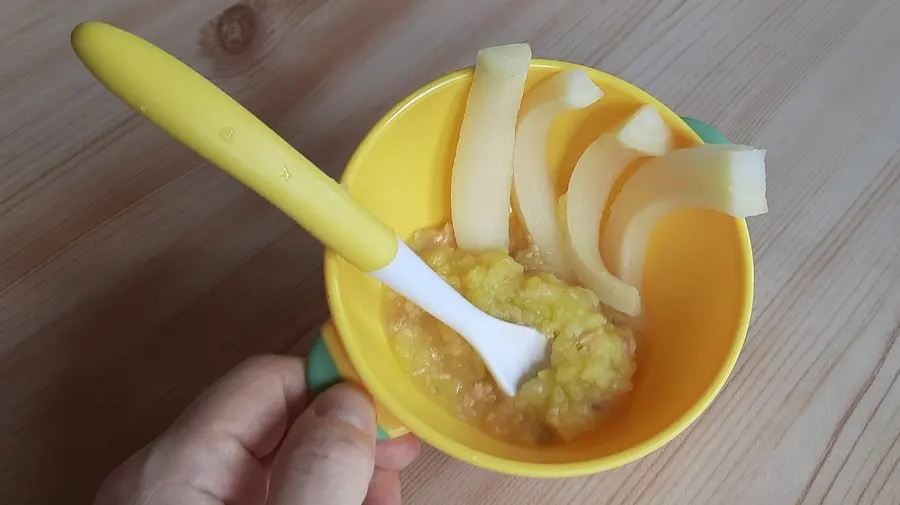
The first spoonful — a huge moment for both you and your baby! But the second you ask the internet, a thousand contradictory rules pour in: "vegetables first," "wait three days," "don't touch peanuts"... This guide cuts through the noise to what current science actually says. Spoiler: it's more flexible and more fun than you'd think.
The big picture: start around 6 months, prioritize iron-rich foods, skip added salt and sugar, and respect your baby's appetite. The rest is detail — let's take it one step at a time.
When to Start? The Calendar + The Signs
The World Health Organization and pediatric bodies set around 6 months as the target. But the calendar alone isn't enough; your baby needs to show these three signs together:
- Can hold their head up steadily,
- Can sit with support in a high chair,
- Can swallow food off a spoon instead of pushing it back out with their tongue.
- "They stare at our food and their mouth waters" alone doesn't mean they're ready — that's just curiosity; wait for all three signs to line up.
- Solid foods are never given before 4 months under any circumstances; for the first 6 months, breast milk (or formula) alone is enough.
The First Spoonfuls: What to Start With?
Toss the order myth in the trash
The claim that "if you don't give vegetables first, they'll get hooked on sweet flavors" has no medical evidence — pediatric bodies clearly state that for most babies it doesn't matter what the first food is. Start with a single ingredient, keep it salt- and sugar-free, and the rest is up to you.
The real rule: iron
- From 6 months on, your baby's built-in iron stores start to run low — which is why iron is king among the first foods.
- Iron champions: pureed red meat, chicken, or fish, well-cooked egg, unsalted red lentil puree, and iron-fortified baby cereal.
- Current advice: your baby should have one animal food every day (meat, fish, or egg) and vegetables and fruit every day; feeding only rice cereal leaves them nutritionally short.
The texture ladder
- 6 months: purees and mashes → 7-8 months: lumpy mashes and soft finger foods → 9-12 months: small soft pieces → 12 months: the family table (with an unsalted portion set aside).
- Dairy such as yogurt and cheese can be given in food from around 6 months; cow's milk as a drink, however, waits until age 1.
Allergens: The Old Rules Have Changed
For years the advice was "delay eggs and peanuts" — major studies showed the exact opposite: DELAYING allergens doesn't protect, introducing them early and regularly does. Among at-risk babies who were introduced to peanut early, peanut allergy dropped dramatically.
- In a healthy, low-risk baby, well-cooked egg and peanut butter (thinned out, mixed into yogurt) can be introduced along with solids, at around 6 months.
- In a baby with severe eczema or a known food allergy, allergen introduction MUST be done with a doctor's plan — sometimes it's started earlier and under supervision, around 4-6 months.
- A critical detail: whole peanuts and tree nuts are off-limits until age 5 (choking!); use butter or powder forms.
- Introducing isn't enough — you have to keep it up: an introduced allergen should stay on the table 2-3 times a week.
- Give a new allergen early in the day and keep watch. The classic "wait 3-5 days" rule has now loosened: for ordinary NON-allergen foods (zucchini, pear…) there's no need to wait; introduce allergens one at a time.
- Warning signs: hives and vomiting call for the doctor; lip or tongue swelling, trouble breathing, or fainting call for the ER.
Spoon-Feeding or Baby-Led Weaning (BLW)?
There are two schools: spoon-fed purees and BLW, where the baby feeds themselves by hand. Science's answer is reassuring: both are legitimate, neither is superior to the other, and choking risk (when the rules are followed) is no higher with BLW. Most families are happiest with a blend: some puree, some finger foods.
- BLW requirements: the baby must be able to sit, the foods must be finger-length and soft enough to mash with the tongue, and the baby must never be left alone while eating.
- Gagging ≠ choking: Gagging is LOUD (they cough, turn red, bring the food forward) and is a protective reflex — don't intervene, stay calm. Choking is SILENT (no sound, they turn blue) and requires immediate action. Memorize this distinction; watching a first-aid video before birth is worth its weight in gold.
The Red List: Do Not Give
- HONEY — never before age 1: risk of infant botulism. That includes putting it on formula, water, or a pacifier.
- Cow's milk as a drink — not before age 1 (yogurt and cheese are fine).
- Salt — not added until age 1; set the baby's portion aside before salting the food. Same goes for sugar: neither in food nor in drinks.
- Choking hazards: whole grapes and cherry tomatoes (quarter them), whole nuts (until age 5), raw carrot and apple (cook or grate them), popcorn, hard candy, round slices of sausage (cut lengthwise).
- Fruit juice isn't recommended before age 1 — the whole fruit is always better.
- When buying store-bought baby food, read the label: make sure the ingredients don't include salt/sodium or hidden sugar (glucose syrup, "fruit juice concentrate").
How Much? — The Baby Is the Boss of Appetite
- In the early days, even 1-2 teaspoons is a success; breast milk/formula remains the main source of nutrition up to 12 months.
- The baby knows when they're full: if they push the food away, close their mouth, or turn their head, the meal is over. There's no rule about finishing the plate, and no making airplane noises to force-feed.
- Meal rhythm: 2-3 solid-food meals a day at 6-8 months; 3-4 meals plus 1-2 snacks at 9-12 months.
- Water enters the scene alongside solids: small sips at meals from a practice cup (a total of half a cup to one cup a day is plenty).
- Don't give up on a rejected food: liking a taste can take 8-10 tries. Today's "yuck" can be next month's favorite.
Drop Supplements: Don't Forget
- Vitamin D: in Turkey, every baby gets 400 IU a day starting on day 15, free through family medicine — don't skip it up to age 1.
- Iron: through the "Iron-Strong Turkey" program, preventive iron drops are also provided free from month 4 to month 12; your family physician sets the dose.
- Neither one is a substitute for solid foods — they're a complement to them.
Important: Move Forward Together With Your Doctor
This guide is general information compiled from reliable health sources; when to start solids, the allergen plan, and supplements vary from baby to baby, and nothing here is a substitute for an in-person exam. Take your steps under the guidance of your pediatrician and family physician; whenever you're unsure, check with them first.
Related articles

Month-by-Month Baby Development (0–6 Months)
"My neighbor's baby has started rolling over, and mine is still just looking around!"—stop, no comparing. Every baby develops on their own timeline, and the range…
Read article
Moms' Most Common Questions and Worries
The questions you grab your phone and type into a search engine at 3 a.m.... This section is exactly for those. We've gathered the questions moms ask most in…
Read article
Mental Health During Pregnancy and After Birth
Everyone tells you pregnancy is "the happiest time of your life" — and often it truly is. But anxiety, tension, tearfulness, and thoughts like "am I really going to…
Read articleContinue your journey with Momly
Track your week, save what matters and keep every guide in your pocket — on iPhone.
Browse more in Baby Development & Feeding